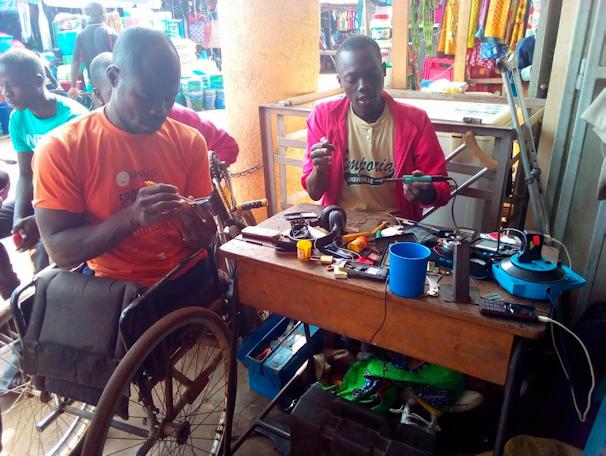
Two entrepreneurs work at a small electronics repair workstation in a busy market. One entrepreneur uses a wheelchair while handling electronic components, and another works beside a table filled with repair tools, wires, and devices. The image highlights entrepreneurship, technical skills, and economic participation among persons with disabilities.
Blog Posts

Beyond 5%: Financing Jobs for Young Nigerians with Disabilities

Nigeria has not been short of commitments on disability and work. The Discrimination Against Persons with Disabilities (Prohibition) Act, signed in January 2019, reserves at least five percent of jobs in public organisations for persons with disabilities and set up the National Commission for Persons with Disabilities to enforce it. In January 2025 the Commission launched the framework for the National Access to Work Scheme, which is meant to supply assistive tools to persons with disabilities employed in the private sector. We at the Center for Inclusive Development support both and want them delivered. But they share a starting point, which is a person who already has, or is about to get, a job with an employer. Many of the young people we work with are not in that position. For them the realistic route is a business of their own, and that is where they meet a different barrier.


https://cid.org.ng/2026/09/18/how-economic-empowerment-can-strengthen-the-safety-independence-of-women-with-disabilities/
Blog Posts

The Loan That Almost Never Comes

Every young person with an idea in Nigeria knows the familiar pattern of having a plan and energy, then going in search of the modest amount of money that turns a plan into a tailoring shop, a phone repair table, or a small delivery route. For most young Nigerians, that search is already difficult. For a young Nigerian with a disability, it is very nearly closed. A recent report from the World Bank, researched across the country by the Youth Chapter of the Joint National Association of Persons with Disabilities, reveals that fewer than 7 in every 100 young persons with disabilities were able to obtain credit from a financial service provider. The rest were turned away, quietly priced out, or never seriously considered in the first place.

Scroll to Top