
By Isaiah Ude
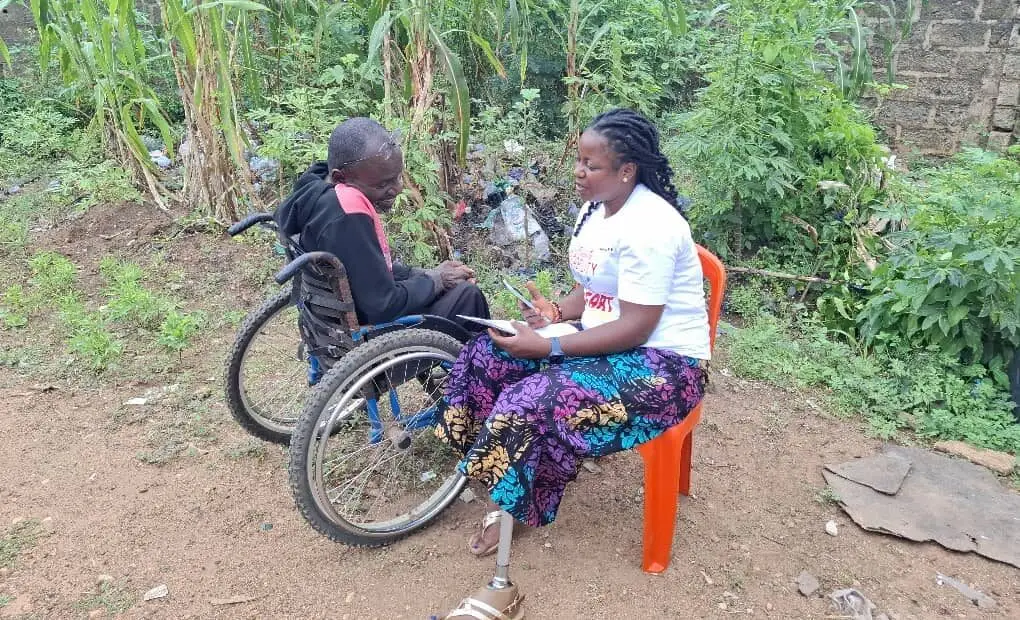
Every young person with an idea in Nigeria knows the familiar pattern of having a plan and energy, then going in search of the modest amount of money that turns a plan into a tailoring shop, a phone repair table, or a small delivery route. For most young Nigerians, that search is already difficult. For a young Nigerian with a disability, it is very nearly closed. A recent report from the World Bank, researched across the country by the Youth Chapter of the Joint National Association of Persons with Disabilities, reveals that fewer than 7 in every 100 young persons with disabilities were able to obtain credit from a financial service provider. The rest were turned away, quietly priced out, or never seriously considered in the first place.
That one statistic explains a great deal about the shape of poverty among young persons with disabilities, and it deserves to be read slowly. Credit is not a luxury in a country where salaried jobs are scarce and where most people build a living from their own small enterprise. Credit is the distance between an idea and an income. When a whole group of young people is locked out of it, they are not simply denied a convenience. They are denied the single most common route out of hardship that the Nigerian economy still offers ordinary people.
According to the World Bank report, only 37 percent of young persons with disabilities are employed at all, and more than half are entirely inactive in the labour market, meaning they are neither working nor searching. Those who do earn something take home an average of about 30,000 naira a month, which comes to roughly 21 dollars, and 71 percent of them live below the national poverty line. These are people with ambition, but the ambition keeps running into a wall built out of collateral they cannot provide, bank branches they cannot physically enter, forms that arrive in no accessible format, and loan officers who read a disability as a business risk rather than a business plan.
The economy pays for this exclusion, and the World Bank estimates that Nigeria loses about 416.8 billion naira every year, close to 288 million dollars, purely from shutting young persons with disabilities out of education, skills, and work. That figure is real output the country never produces, taxes that are never paid, and enterprises that never open their doors. Widen the calculation to include every working-age person with a disability and the annual loss climbs to about 3.77 trillion naira, or 2.5 billion dollars. A country that talks constantly about diversifying its economy is leaving one of its most motivated groups of would be founders standing outside the bank.
ALSO READ: How Economic Empowerment Can Strengthen the Safety, Independence of Women with Disabilities
What makes the credit gap frustrating is that the fix is well understood and, by the standards of national spending, affordable. The report models what it would cost to close the exclusion, and it finds that economic empowerment through loans and grants is the single largest and most powerful lever available. Depending on how ambitious the country chooses to be, the price runs from about 543 billion naira at the modest end to as much as 2.72 trillion naira at the most generous end. Set that against the losses the exclusion already produces every year, and the investment begins to look less like spending and more like a country finally collecting money it has been leaving on the table.
Money alone will not do the job, though, if it flows through the same channels that failed in the first place. A grant scheme that asks a beneficiary to travel to an inaccessible office, complete a form no screen reader can interpret, or produce collateral that a person shut out of employment could never have accumulated will simply reproduce the exclusion under a friendlier name. The design of the pipe matters as much as the water inside it. Financial institutions that genuinely want to reach this market will need accessible branches and digital platforms, loan products built for customers with thin or absent credit histories, and staff who have been trained to see a customer rather than a condition.
When almost no one in a community can reach formal credit, the informal alternatives that rush to fill the gap tend to be expensive and precarious. The report notes that nearly 92 percent of young persons with disabilities pay for healthcare directly from their own pockets, because social protection barely reaches them. A single illness or family emergency can wipe out whatever small savings a young trader has managed to build, and with no access to formal credit there is no way to recover except to borrow at punishing rates or to abandon the enterprise altogether. Exclusion from finance is therefore not a one-time barrier that a person eventually clears. It is a trap that keeps resetting a life back to zero.
None of this is inevitable, and that is the most important thing to carry away from the numbers. The young people with disabilities described in this report are not a problem to be managed. They are a market that has been ignored, a workforce that has been benched, and a generation of founders whose businesses are waiting on a decision that keeps being deferred. Closing the credit gap is not an act of charity toward them. It is an act of competence by a country that says it wants growth and then walks past one of its clearest sources of it.
At the Center for Inclusive Development, we read a figure like 6.9 percent not as a footnote but as an agenda. It tells us exactly where the next round of work belongs, in the rooms where financial products are designed, where loan criteria are written, and where the assumption that disability and enterprise cannot sit together still quietly rules. The work now is to make sure that the next young person with a good idea and the courage to chase it walks up to a door that opens rather than one more that stays shut.